
BEFORE YOU SHIP / 02
THE PACKING LIST
Make the Shipment Visible on Paper
A practical guide for shippers, exporters, exhibitors and anyone preparing freight for international transport.
SUPATH | International Air Freight & Trade Consultancy
1. Why Does the Packing List Matter?
Is a packing list always mandatory? No. Is it useful? Very often, yes. Can the commercial invoice and packing list be combined? They can, provided the resulting document remains clear and contains the information required for the shipment and customs procedure.
A packing list is often treated as an insignificant document. It should not be.
The commercial invoice normally provides the commercial description and value of the goods. The packing list explains how the physical shipment is arranged: what is packed, where it is packed, how many pieces there are, and the relevant weights and dimensions.
For a mixed shipment, the customs representative and freight forwarder may need to connect each commodity with its quantity, net weight, description and other classification information. The easier the documents are to reconcile, the easier it is to prepare the customs declaration and organise the transport.
In the optimum case, the commercial invoice and packing list can be placed side by side. Their descriptions and item sequence correspond. The commercial information comes from the invoice; the physical packing information comes from the packing list.
SUPATH PRINCIPLE: The two documents should tell the same story from two different perspectives.
2. Identify the Documents and the Shipment
Before the goods can be identified, the documents themselves must be identifiable. Call the documents what they are: Commercial Invoice, Pro-Forma Invoice where appropriate, and Packing List.
A packing list should carry a clear reference. Where practical, link it to the commercial invoice and other shipment references.
-
Packing-list number or reference
-
Date
-
Commercial-invoice reference
-
Purchase-order number where relevant
-
Shipper/exporter
-
Consignee
-
Other useful shipment or project reference
The objective is simple: if the packing list becomes separated from the rest of the paperwork, the reader should still be able to determine which shipment it belongs to.
3. Identify Every Package
A 'package' is a generic term. The freight forwarder needs to know what the physical unit actually is.
-
Carton
-
Pallet
-
Wooden case or crate
-
Metal box
-
Flight case
-
Big bag or other suitable package type
The forwarder may also need to know whether the package is stackable, shock-sensitive, temperature-sensitive, requires a forklift or pallet truck, can be carried manually, or has other handling limitations.
Do not stop at '5 packages'. Tell the reader what those five packages are.
4. Number the Packages
Imagine a consignment of 100 packages with no external identification. Nobody should have to open packages merely to discover what they contain.
Number the packages clearly and connect the numbering to the packing list. A simple system works:
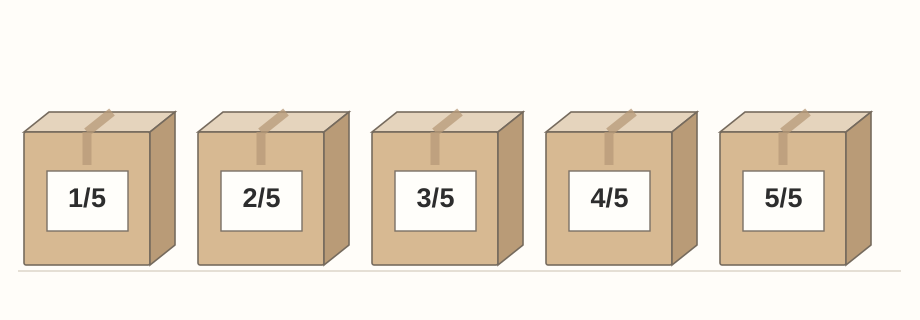
The number shown on the physical package should correspond with the number shown on the packing list.
5. Document the Contents
For each package, state what is inside it. Where a shipment contains several commodities, show which items are packed in which package.
Keep the item sequence and descriptions aligned with the commercial invoice wherever practical. The person handling your freight is not an employee of your company and does not know your internal product names or abbreviations.
Avoid: DK26i96ja - 2 sets.
Prefer a description that a person outside your company can understand, for example: One pair of electrical plastic sockets, male and female, maximum 16 A.
The purpose is not to write an engineering manual. It is to remove ambiguity.
6. Quantity and Units
State the quantity of each item and use an appropriate unit. Avoid an unexplained 'set'. If a set contains several components, say what the set consists of.
-
pieces
-
pairs
-
rolls
-
metres
-
square metres
-
litres
-
sets consisting of specified components
7. Net Weight
If a document says only 'weight 2 kg', the next question is obvious: with or without the packaging?
State net weight explicitly. Where different commodities or classifications are declared separately, the customs representative may need a net weight attributable to each relevant item or commodity line. Do not expect the forwarder or customs representative to guess it.
Example: Net weight: 125.5 kg.
Use a consistent unit and sensible precision. Do not create false accuracy merely by adding decimal places.
8. Gross Weight
Gross weight is the weight of the goods including their packaging.
Show the total gross weight of the shipment. For multi-piece shipments, package-level gross weights are extremely useful and may be operationally necessary, especially where pieces differ significantly in size or weight.
The sum of the individual package weights should reconcile with the total gross weight.
9. Dimensions - Always Include the Unit
Dimensions are not decoration. They determine how the shipment can be collected, handled, stored and loaded.
I have seen a cleared shipment fail at the collection stage because the vehicle sent to the warehouse could not take the cargo. The dimensions had been provided, but the unit had not. The figures were inches, while they had been understood as centimetres.
Write dimensions in a consistent order, normally Length x Width x Height, and always state the unit.
Example: 120 x 80 x 130 cm.
A number without a unit is incomplete information.
10. Why Dimensions Matter Particularly in Air Freight
Air-freight loadability depends not only on weight but also on the aircraft, door openings, compartment geometry, unit load device or pallet configuration, route and airline operating requirements.
A piece that appears modest in size may still be unsuitable for a particular passenger-aircraft lower deck or routing. Do not rely on a single universal height rule. Give the freight forwarder accurate dimensions and allow the forwarder or airline to confirm loadability.
This is one reason dimensions must be measured before the shipment is booked, not discovered after it reaches the warehouse.
11. Chargeable Weight
Chargeable weight is not normally something the shipper needs to enter on the packing list. In air freight, it is the weight used for freight-rating purposes and may differ from the actual gross weight because volume can affect the calculation.
SUPATH will cover chargeable weight separately in the general air-freight guide.
12. Marks, Names and Numbers
Air freight may travel on passenger aircraft as well as dedicated freighters. Multi-piece consignments can also be separated operationally during the journey.
Every package therefore needs clear external identification. If an airline or warehouse label becomes detached, your own markings can be invaluable.
Consider placing the following on each package:
-
Shipper
-
Consignee
-
Destination
-
Package number / total packages (for example 1 of 10)
-
Air Waybill number when available and appropriate
The external marks and the packing list should correspond.
13. Serial Numbers and Identifiable Equipment
For machines, devices and other individually identifiable equipment, record serial numbers or other permanent identifiers where relevant.
This is particularly useful for temporary movements, demonstration equipment, return shipments, repairs and testing.
For return or re-import procedures, customs may need evidence that the returning equipment is the same equipment that previously left. A clear serial number or other permanent identification can therefore be extremely important.
14. Wooden Packaging and ISPM 15
Solid wood packaging material deserves separate attention. ISPM 15 regulates many forms of raw-wood packaging used in international trade, including pallets, crates, cases and dunnage.
Where ISPM 15 applies, use compliant treated and correctly marked wood packaging. However, not every material commonly described as 'wooden packaging' falls within the standard. Packaging made wholly from processed wood such as plywood, particle board, OSB or veneer is among the exemptions described by ISPM 15.
Do not assume. Confirm the requirements for the material and destination before shipping.
SUPATH will treat ISPM 15 and solid wood packaging in a separate guide.
15. Handling Information Must Be Visible
Important handling instructions should not exist only inside the packing list. Warehouse and airline handling staff may work primarily from operational cargo information and the markings visible on the package.
-
THIS SIDE UP
-
FRAGILE
-
KEEP DRY
-
DO NOT STACK
-
CENTRE OF GRAVITY
-
LIFTING POINTS
-
Other genuine handling restrictions
Use appropriate, clearly visible package markings and labels. Where regulated labels or marks apply, use the prescribed form rather than an improvised substitute.
16. Oversized and Heavy Engineering Cargo
Heavy and oversized freight needs exact information. Do not estimate dimensions or weights simply because the cargo is difficult to measure.
-
Exact external dimensions
-
Reliable gross weight
-
Centre of gravity where relevant
-
Lifting points
-
Forklift pockets or access
-
Whether the piece may be tilted
-
Whether it is stackable
-
Any protrusions or irregular shape
The information affects vehicle selection, warehouse handling, lifting equipment, aircraft loadability and sometimes route planning.
Measure carefully. Weigh reliably. Do not create false precision, but do not guess.
17. Exhibition Shipments
Exhibition consignments deserve particular discipline because temporary equipment, tools, consumables and promotional material can all travel together while having very different customs treatment.
Keep the commercial invoice, ATA Carnet where applicable, packing list and physical packages logically aligned.
-
Pack and identify machines or devices clearly.
-
Separate tools and accessories where practical and identify the package.
-
Keep brochures, catalogues, flyers, giveaways and other items that will remain in the destination country distinguishable from goods intended to return.
-
Use large, legible package identification. It should be readable during warehouse and forklift handling.
-
An additional 'Exhibition Material' label may be useful, but it should never be the only description or identification.
For an exhibition shipment, the return journey should already be considered when the goods are being packed for the outward journey.
18. Dangerous Goods
A packing list is not a substitute for dangerous-goods classification, packing, marking, labelling or documentation.
If the shipment contains batteries, chemicals, gases, aerosols, dry ice, fuels or other potentially regulated articles, establish the dangerous-goods status before offering the cargo for air transport.
The shipper remains responsible for correct classification and compliant preparation. Use appropriately trained and competent personnel and the current applicable dangerous-goods requirements. Do not improvise.
SUPATH will not attempt to turn a general packing-list guide into a dangerous-goods manual.
19. The Packing List Must Match the Physical Shipment
There is very little room for error here.
-
Six packages on the packing list should correspond to six physical packages.
-
The stated weights should correspond with reliable measured weights.
-
120 x 80 x 80 cm on the packing list must not turn out to mean 120 x 80 x 80 inches.
-
The item stated as being in Package 3 should actually be in Package 3.
Never prepare the final packing list from what the shipment was supposed to contain. Prepare it from what was actually packed.
Copy-and-paste can end in regret - and cost.
20. The Reality Check
Before releasing the shipment, compare the document with the cargo on the floor:
-
How many packages are physically present?
-
How many packages are shown on the packing list?
-
Do the package types correspond?
-
Do the dimensions and weights correspond?
-
Do the item descriptions correspond with the commercial invoice and the physical contents?
-
Are the packages clearly labelled and numbered?
21. The Critical Test
Ask someone who was not involved in the packing to locate one particular item using only the packing list and the package markings.
If that person cannot find it without opening random packages or asking the packing team for help, the documentation can probably be improved.
This is one of the simplest tests of whether a packing list actually works.
22. Final Packing List Checklist
-
Packing-list reference
-
Date
-
Commercial-invoice reference
-
Full shipper details
-
Full consignee details
-
Total number of packages
-
Package numbering
-
Packaging type
-
Contents of each package
-
Clear goods descriptions
-
Quantity and units
-
Net weight
-
Gross weight of each package where useful or required
-
Total gross weight
-
Dimensions of each package
-
Units for weights and dimensions
-
Marks and numbers
-
Model numbers where relevant
-
Serial numbers where relevant
-
Special handling information where applicable
-
Wood-packaging information where applicable
-
Packing list agrees with the commercial invoice
-
Packing list agrees with the physical shipment
23. The One Master Rule
Crystal clear. No loopholes. No guessing.
A good packing list should make the shipment visible on paper. A person who has never seen the cargo should be able to understand how many packages exist, what they contain, how large they are, how much they weigh and how they can be identified.
Success in freight begins before the shipment moves.
Publication Note
This guide is practical general information based on long-standing freight-forwarding experience. Exact customs, transport, airline, dangerous-goods, phytosanitary and destination requirements depend on the goods, route, procedure and jurisdiction. Where a regulated or uncertain matter applies, verify the current requirement with the competent authority, carrier or appropriately qualified specialist.