
Minimising Stress Factors in Air Freight Packaging
BEFORE YOU SHIP — SUPATH
Minimising stress factors in airfreight packaging? Is that more important than all the other innumerable factors? Why should stress factors be minimised? Can they not be overruled by taking the necessary steps? If the packaging is strong and sturdy, how can the stress factors act on the shipment? Surely, other criteria should take precedence over dealing directly with risks.
The staff responsible for packaging are experienced. They know the materials and how to configure the packaging to withstand transport. Their experience enables them to assess the stresses a shipment may encounter. Indeed, they know that stress factors will act upon the package. However, let us move our attention away from the strength of the materials and their resistance to an entirely different arena: the dynamic nature of air cargo transport.
The packaging materials have been chosen with care. The members of staff responsible for packaging are experienced. Hence, you think that attention can be moved to other areas of the plan, so that you do not lose valuable time. You know time is money. Hence, you intend to optimise your planning to achieve cost efficiency through logical time management.
Since cost efficiency is a very important factor, let us strengthen the staff by widening their view of the strength and resilience of the packaging practices. We can broaden their knowledge about stress factors. That will help meet the goal of optimising the natural durability of the packaging. The safety of the product is dependent on the packaging. The safety of the package is dependent on its strength. We need to think about the stress factors that could affect that strength. Let us first understand those factors.
For centuries, armies all over the world have been following one particular rule, which might sound unimportant but they do it. When the marching soldiers reach a bridge, they cease marching and break into standard walking. Continual vibration in a rhythm could take the bridge apart. In the same way, certain forces acting on a package can cause structural weakness.
A journey in motion
Let me take you on a small visual journey. It will be one that corresponds to what my life in freight forwarding taught me. Read this small passage carefully and focus only on what the passage echoes in your mind. Then sit back, exhale all your breath slowly, breathe in very slowly, and visualise the following. It will unfold a clear vision of what is happening. You will absorb a situation visually, without interference from what you might be thinking.
You are sitting in a chair at the back of a lorry cabin. Your chair is fixed safely to the floor of the lorry. You are secured by a seatbelt. The lorry cabin is carrying only a carton. The carton contains a heavy load. It is sitting next to your seat, on the floor. The lorry begins to move. It is gradually increasing its speed at a steady pace. As the speed picks up, you notice that your back is pressed against the seat. The carton is still. No movement. The speed of the lorry is steadily increasing. The road in front is free of traffic.
Abruptly, the driver slams on the brakes. You gasp. Your body is catapulted forward. Your seatbelt keeps you in place. You feel the seatbelt biting into your collarbone as it restrains you. What happened to the carton? Only visualise what happened to the carton.
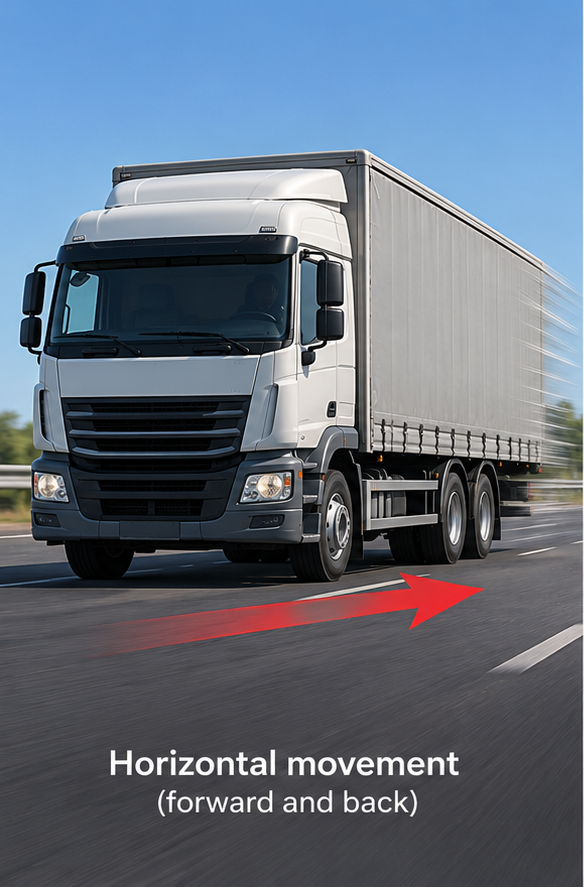
A weakly secured freight escapes its harness and moves horizontally forward. Its path is defined by the force acting on it from behind, catapulting it against the first obstacle in its path. Depending upon the force of the impact, an opposite force comes into play. A violent crash against the obstacle in front will generate a recoil, sending the object backwards in the line of the force acting on it.
A package in motion moves along a plane. The movement is transferred to the contents. That movement is along the same plane as before. What you are observing is the object being acted upon by the force that moved from the plane outside and continued to the inside. The contents became part of the movement. They might or may not undergo a transformation. The fact is that a force acted upon them.
As the lorry moved forward, the driver, distracted by something, did not see the approaching pothole. The shock of hitting the pothole instantly activated a reflex natural to human beings. He slammed on the brakes. The lorry dipped into the pothole; the air suspension cushioned the descent by giving in and then gently resisting it. The result was a downward dip and an upward lift. You guessed it correctly, up and down. That is the vertical plane.
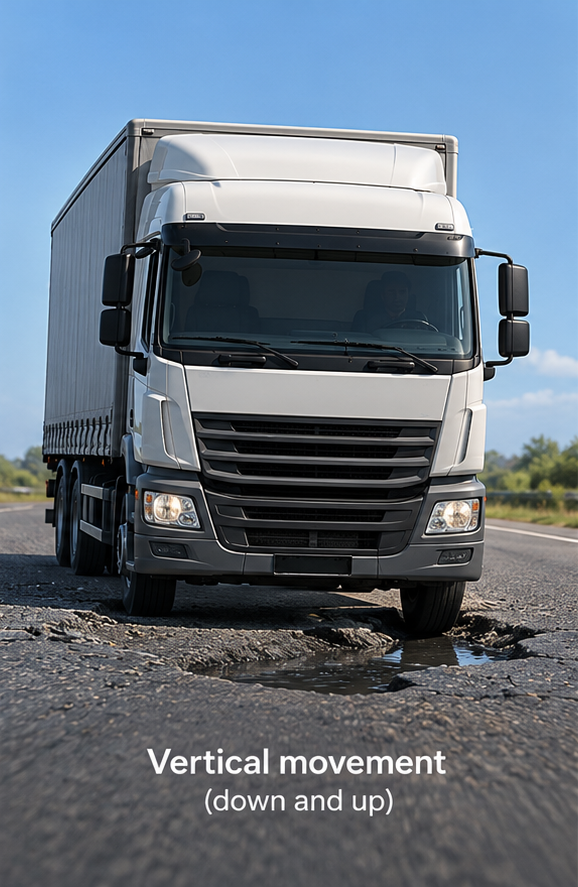
You know that every action is the cause of a reaction. As the air suspension went through the process of dipping and lifting, the vehicle moved in unexpected ways. A slight movement to the side and then a compensation to the opposite side. Engineering is something fascinating. The inbuilt counteractivity of stabilising. Motion is an interesting phenomenon. That sideways movement was a wonder of engineering. You are thinking of that movement now. The not-so-gentle, but probably not-so-hard, movement to the left and a compensation to the right as the air suspension reacts with engineered perfection. Did I say left to right or vice versa? That is what we call the lateral plane.
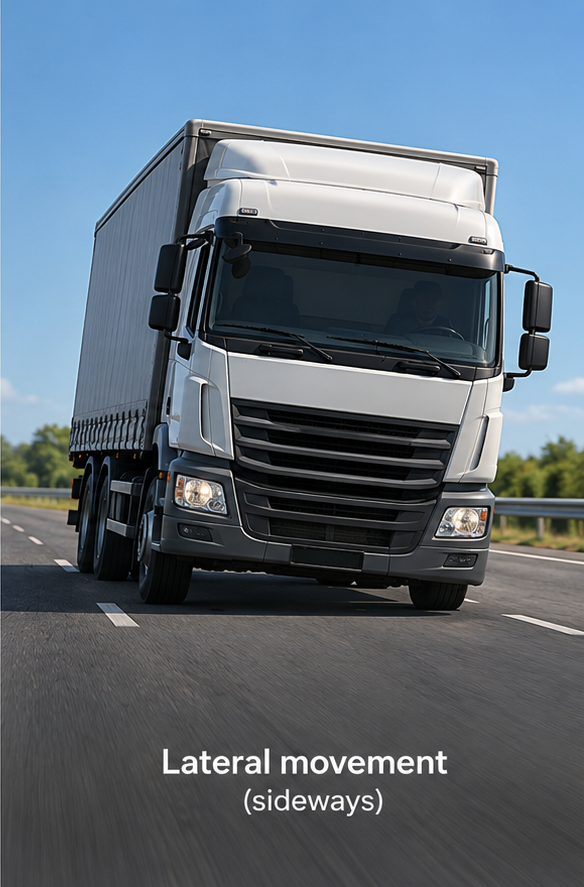
Now that you have seen what happens to a consignment, we just need to recognise that, by adding to the knowledge of your experienced staff, we are introducing the need to reinforce the strength of the packaging materials with a shock-absorption mechanism on all sides. That way, the forces acting on the horizontal plane (front and back), on the vertical plane (top and bottom) and on the lateral plane (sideways) can be absorbed by the padding. All that you need to consider is the density of the contents and the corresponding protection needed, without adding too much to the weight. All that I would request of you is to consider the environment in your planning.